stake that can have a real impact on women’s lives, from access to reproductive healthcare to better family leave policies to ensuring pay equity.
�That women continue to show up to the polls is important. But while many politicians and PACs often focus their energies on convincing Gen Z to register to vote (which yes, please do!) and Baby Boomers to empty their pockets, it’s older millennials and Gen Xers—women who find themselves in that “middle age” phase of life—who are sometimes overlooked, and yet who wield real and unique power.
In part because they’re literally in the “middle” of it all. The life experiences of middle-aged women vary greatly, meaning they’re affected by a wide range of issues. Some are just hitting their career strides, while others are preparing for retirement; plenty have toddlers or teenagers at home, while others are grandmothers. Many have no children. They’re still paying off their student loans or sending kids off to college—or both. But it’s not just about their own vote—women in this demographic are influential across generations. Many have a Gen Z voter in their orbit; many are responsible for getting their elderly loved ones to the polls.
W
omen don’t just vote—they determine elections. Since 1980, women have registered and voted at higher rates than men in every presidential election, with the turnout gap only growing every four years. It makes sense. There are major issues at
Given the crucial role women play in the upcoming presidential election, Marie Claire teamed up with the University of Massachusetts Lowell’s Center for Public Opinion to take a closer look at this mighty group of midlifers. Together with YouGov, a market research company, we surveyed a sample of more than 1,000 nationally representative, likely voters, as well as an additional 673 women aged 40 to 60, before chatting further with respondents who were open to sharing their opinions. The survey was conducted about three weeks after Vice President Kamala Harris joined the race.
�“These women are decidedly understudied in American politics,” says John Cluverius, the associate director of the Center for Public Opinion, noting that Gen X is a particularly fascinating political group—they’ve voted roughly 50 percent Democrat and 50 percent Republican since they were teenagers, while most generations start out more liberal when they’re young and become more conservative as they age. The majority came of age with Reagan and a very dominant Republican party in the ’80s and ’90s, when even Democrats had a more conservative orientation on economics, crime, and social issues. In the years since their early adulthood, this group of women were among the first to plot (or expect to plot) their educations, careers, and families, which they did against the background of multiple Middle Eastern wars, the advent of the internet and cell phones, 9/11, the great recession, and the first felt effects of climate change.
�So what do they care about now?
�Unsurprisingly, a lot. Our survey revealed the top issues on middle-aged women’s minds this election, as well as if—and who—they’ll vote for. Let’s start there.
(Photo credit: Getty Images)
VOTING
Marie Claire partnered with the University of Massachusetts Lowell’s Center for Public Opinion to understand what middle-aged women really think about the election and the ways they could impact the results come November.
BY Kaitlin Menza

They’re happy with the candidates—and one in particular.
�While the vibes toward choosing between former President Donald Trump and President Biden were overwhelmingly negative—or exasperated, or bored—in the first half of 2024, middle-aged women are now mostly feeling good about their options. A surprising 60 percent said they’re happy with the presidential candidates on the ballot this cycle, and a good chunk, at 40 percent, said they’re more excited to vote than they were in other recent elections, which could certainly translate to greater turnout.
�A middle-aged woman herself might be the source of this buoyant energy. According to our poll, Vice President Kamala Harris is the presidential pick for middle-aged women, with 49 percent of the vote to Trump’s 41 percent.
�“After Harris joined the ticket, I actually got very, very excited,” said survey respondent Emily Mause, 49, a registered independent from Tempe, Arizona. “I love that they keep using that word ‘joy,’ because that has so been missing. I think people are missing out on actually how wonderful the United States is because we’re so focused on the divisiveness.”
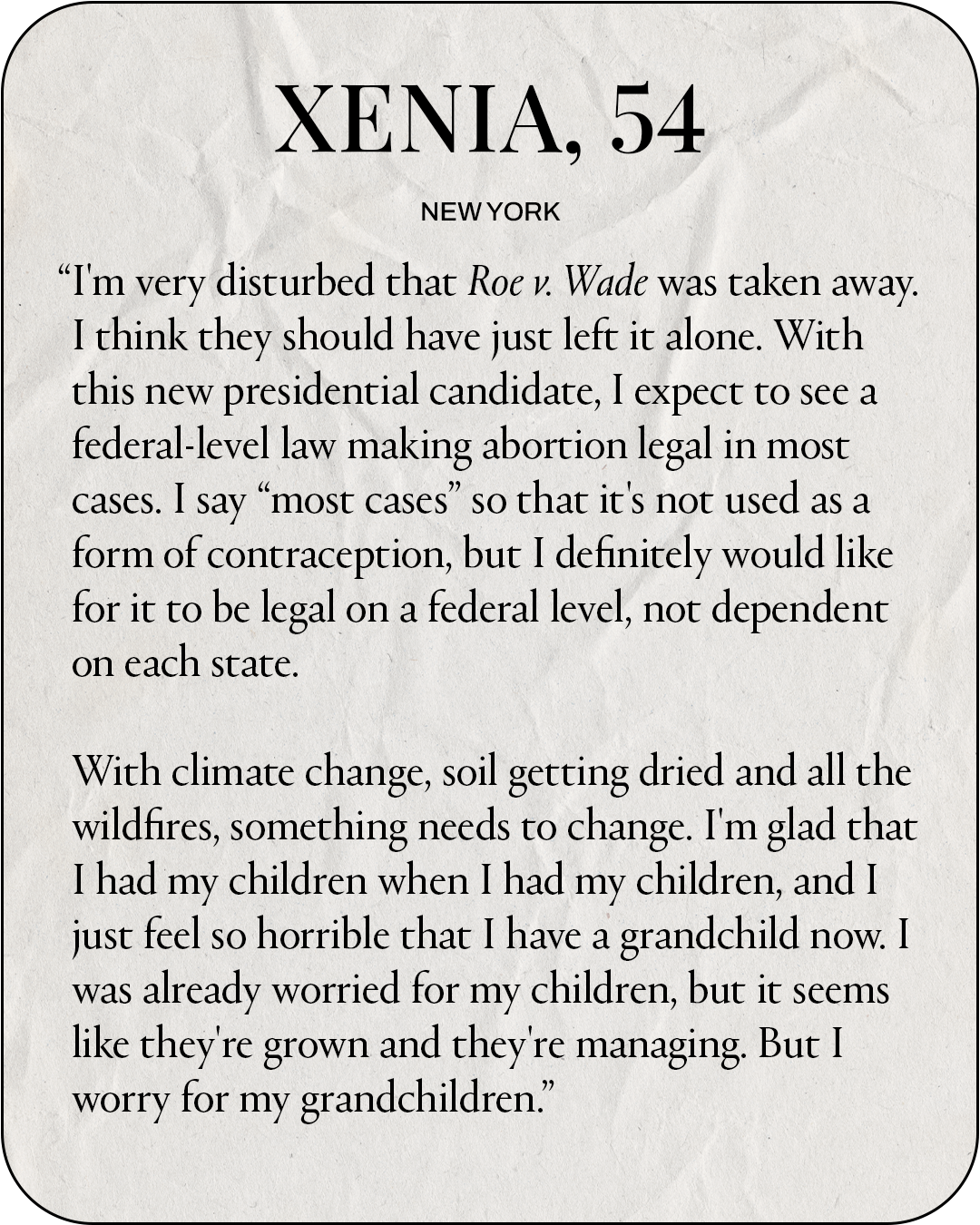
�The energy was echoed by Xenia Mayas, 54, a moderate in Rochester, New York: “I’m very happy that Kamala Harris stepped up to the plate and that Joe Biden stepped down because I was concerned with those two. I said, ‘Oh my gosh, what am I going to do, not vote?’”��
The thrill wasn’t rooted only in relief that Biden had left the race; respondents expressed delight in Harris as a person. She sounds “more down to earth,” explains Elizabeth, 58, a Democrat in Missouri. “When she speaks, she seems like a genuine, real, warm person,” adds Natasha Harhold, 53, a Democrat in Charleston, South Carolina. Susan, 52, a self-described socialist from Chicago, admired the leadership skills she believed Harris showed as a prosecutor. “She takes action, she gets things done,” she said.
�Patti, 59, a Republican from Florida, had other words to describe Harris: “Horrible. An idiot.” She is among that 41 percent voting for Trump. “Yes, he’s got a big mouth and he sometimes doesn’t know when to shut it, but I mean, he’s a good businessman, and that’s what we need with our economy…The Democrats have done a good job at pretty much ruining the country as it stands, and I’m very concerned.”
�But they don’t have a lot of hope for the future.
�The Harris boost is where the uplift ends for women aged 40 to 60, however. The majority of respondents (66 percent) said they’ve become more pessimistic about the future of the country in the last few years. “Coming out of a global pandemic and the presidency of Donald Trump, which was not necessarily friendly to women…it’s not surprising that women might feel besieged these days,” says Kathleen Dolan, a political science professor at the University of Wisconsin Milwaukee and author of When Does Gender Matter? Women Candidates and Gender Stereotypes in American Elections.
The list of worries can feel endless for this group. “I’m extremely concerned about what seems to be non efforts towards preventing further warming of global temperatures by the United States,” says Lauren Thomas, nearly 40, a Democrat from Michigan. “I’m worried about increasing rates of homelessness. I’m worried about the healthcare system, which seems to be in a slow collapse.” As a teacher, she’s also anxious about Trump’s potential plans to “dismantle” the Department of Education.
�Trump’s MAGA motto centers an essential pessimism—the belief that the country is not doing as well as it used to be—so it tracks that among all the Republican respondents in our survey, a whopping 93 percent said the country is on the wrong track.
�But experts say such moods are not wildly uncommon across history. “Generally, a lot of people’s optimism and pessimism depends on whether their party’s in power,” says Erin Cassese, a professor of political science and international relations at the University of Delaware. “Everything is filtered through this partisan lens. When people aren’t in power, they feel like they’re losing and things are getting worse.”�
The economy is their top issue by a landslide.
�The cost of food, homes, everything, is top of mind for middle-aged women regardless of party, our survey found. When asked which recent event had the greatest impact on their current political views, inflation and economic concerns were picked most often; this demo also reported it as the most divisive issue among their peers.
�“I’m buying more in bulk. I stopped streaming services. I cut down on subscriptions. I cook at home, I don’t eat out,” said Mayas, who is disabled and depends on SNAP benefits. “I’ve really had to penny pinch in order to feel comfortable with all this inflation.”
�It’s a pain Thomas can relate to. “My household in total earns under $80,000 with two adults, so this has impacted our ability to have any money left over after bills are paid and groceries are purchased,” she said. “No vacations, no frills.” Grocery prices came up again and again. “Sometimes I look at meat in the grocery store and try to remember what it felt like to buy it,” Patti said.
�It’s not surprising that inflation is the stickiest concern for Americans going into the election, says Tiffany Barnes, a professor of comparative politics at the University of Kentucky and the co-author of Women, Politics, and Power: A Global Perspective. “Of all the issues we think of as being hot-button political topics, this is the one that affects people’s day-to-day lives. They go to the gas station, to the grocery store, to their favorite restaurant, and they’re constantly confronted with inflation,” she says. ��
Other issues can feel less salient, especially if they are nebulous (climate change), complicated (healthcare), or literally far away (the war in Gaza). Put another way, “Kitchen-table issues are called kitchen-table issues for a reason,” Cluverius says. “The easier an issue is to understand, the more it affects their decision-making. It is impossible for experts to convince someone that the economy is good if they feel that it is bad.”
�They’re deeply worried about reproductive rights, too.
�Then there’s the Dobbs decision, the Supreme Court case that overturned Roe v. Wade and created a cascade of legislation across the country limiting access to abortion and other reproductive healthcare. Two-thirds of middle-aged women surveyed disagreed with the decision, compared with 59 percent of all respondents, and 51 percent of men.
�“I have five granddaughters, so one of my strongest beliefs is in body autonomy,” said Denise, a Democrat from Columbia, Maryland. “I don’t want any politician telling them when they have children, if they have children, if they can use birth control, if they can use IVF. If they have an ectopic pregnancy, I don’t want their doctor to worry that they can't terminate it because they might be arrested and thrown in jail.”��
The majority of women aged 40 to 60 would also like to see abortion policy handled on the federal level. “We can’t reenact Roe v. Wade necessarily, but there can be federal legislation that would enshrine abortion rights,” Harhold said. “I don’t think women should have to travel to have an abortion if they need one.”
�It makes sense that middle-aged women in particular would feel so strongly, Barnes says. “Women on the higher end of this age bracket are less likely to take reproductive rights for granted,” she says. “One of the reasons we’ve seen the Harris campaign lean into reproductive rights so much is because it is a galvanizing issue, and something that will turn people out to the polls.”
�When it comes to social issues, particularly immigration and trans rights, they’re more conservative.
�The second most divisive issue in our survey: immigration. “They need to stop people coming over because the crime rate’s going up,” Elizabeth said. Patti agreed: “I would like for 10 or 11 million people not to just walk over the border into our country and do whatever they want. The government's paying for them to have hotels and whatnot, and our veterans are out in the street.”
�Respondents expressed resistance to LGBTQIA+ issues, too, with 56 percent saying that acceptance of LGBTQIA+ lifestyles has gone too far in this country. The transgender panic that seems to overwhelm Fox News and Facebook has taken root in this population, with 58 percent disagreeing with the idea that transgender people should be allowed to use the public facilities that match their gender identity. ��
Such wide-sweeping homophobia and transphobia is startling, but Dolan suspects such leanings come down to the age bracket. “Younger people are obviously more supportive of LGBTQ+ rights than older people,” she says. “I think that people hear about it to an outsized degree and therefore think that it is happening more often than it is, and that makes it feel threatening to some people—probably the older people in the sample, and certainly the Republicans.”
�And while 83 percent of middle-aged women in our survey wanted an immediate ceasefire in Gaza, and 64 percent wanted Medicare for all, the topics did not rank nearly as highly as inflation.
�Kindness is on the ballot.
�When looking forward, especially for the children in their lives, middle-aged women once more asserted their apprehension: 55 percent said they feel pessimistic about their kids’ future in the U.S. “The hatred that I see in this country is just overwhelming right now,” Denise said.
�They’re old enough to remember, too, when the nation didn’t feel nearly so divided. “I have really good friends on both sides of the line and if we’re not talking politics, they have such good hearts,” Mause said. (In our survey, 21 percent of respondents said they don't talk to women they're close to about hot-button issues.) “I think we need to get back to just people being able to disagree on policy without vilifying each other. Then we'll be on the right track.”�
Explore more stories from this package:
Six Political Races You Should Know About
Are White Women Going to Do It Again?
/
How to Talk to a Gen Z Voter In Your Life
Impact the Election Even If You Can’t Vote�
/


I think we need to get back to people being able to disagree with each other on policy without vilifying each other.
“
From reproductive healthcare to climate change, there are critical issues on the ballot all across the country. Here’s how you can get involved no matter where you live.
Six Political Races
You Should Know About
READ MORE
How to Talk to the
Gen Z Voter
In Your Life
“I really wish my parents had conversations with me about the power of my vote instead of having to learn it on my own.”
READ MORE
AreWhite Women
Going to Do It Again?
They’ve voted majority Republican for the past 70 years in all but two presidential elections.
A look at what we can expect this time.
READ MORE
Impact the
Election
Even If You Can’t Vote
Missed the deadline to register? Unable to cast a ballot for some other reason? There are still ways you can make a difference.
READ MORE
What’s Influencing Their Vote
Click through to hear more from the women in our survey.


(Photo credit: Getty Images)

(Photo credit: Getty Images)

(Photo credit: Getty Images)